How AI Impacts the Layer Cake
 Ryan Rapp
The Layer Cake of Business
In today's post we explore how modern businesses create and capture value through an interconnected "layer cake" of automation and human expertise. As AI reshapes entire value chains, it's tempting to think platforms and automation can replace every human role.
Looking at patterns in successful AI startups, we see a competitive advantage comes from understanding how automation accelerates work and amplifies how creators and experts add indespenable value. This article breaks down that layer cake, shows how AI is compressing layers, and highlights opportunities for leaders to build AI-enabled operational layers that improve quality, scalability, and collaboration without sacrificing nuance or control.
Internet companies as modern platforms
Traditionally businesses sell concrete goods and services. However, throughout the Internet era, businesses have captured unprecedented revenue and profitability through creating and scaling automated systems. Automated systems operate somewhere in between a product and a service - they are adaptable and customized like a service, but simultaneously offer the scale, pricing, and availability of a product.
Automated systems are a layer cake
Automated systems that enable modern businesses are extremely complex, much like a digital supply chain that runs its entire length with each transaction. In software, we describe these as a "stack." What begins as a single click traverses numerous first-party and third-party services (cached or in real-time) to fulfill a request. This allows companies to quickly connect existing services to create or improve an automated system, while avoiding the delays and costs of building from scratch.
In real-world usage, automated systems often veer off track, fail to meet customer quality demands, or require human oversight for security or regulatory purposes. Accordingly, automated systems are interwoven with professionals who own critical sections to ensure success.
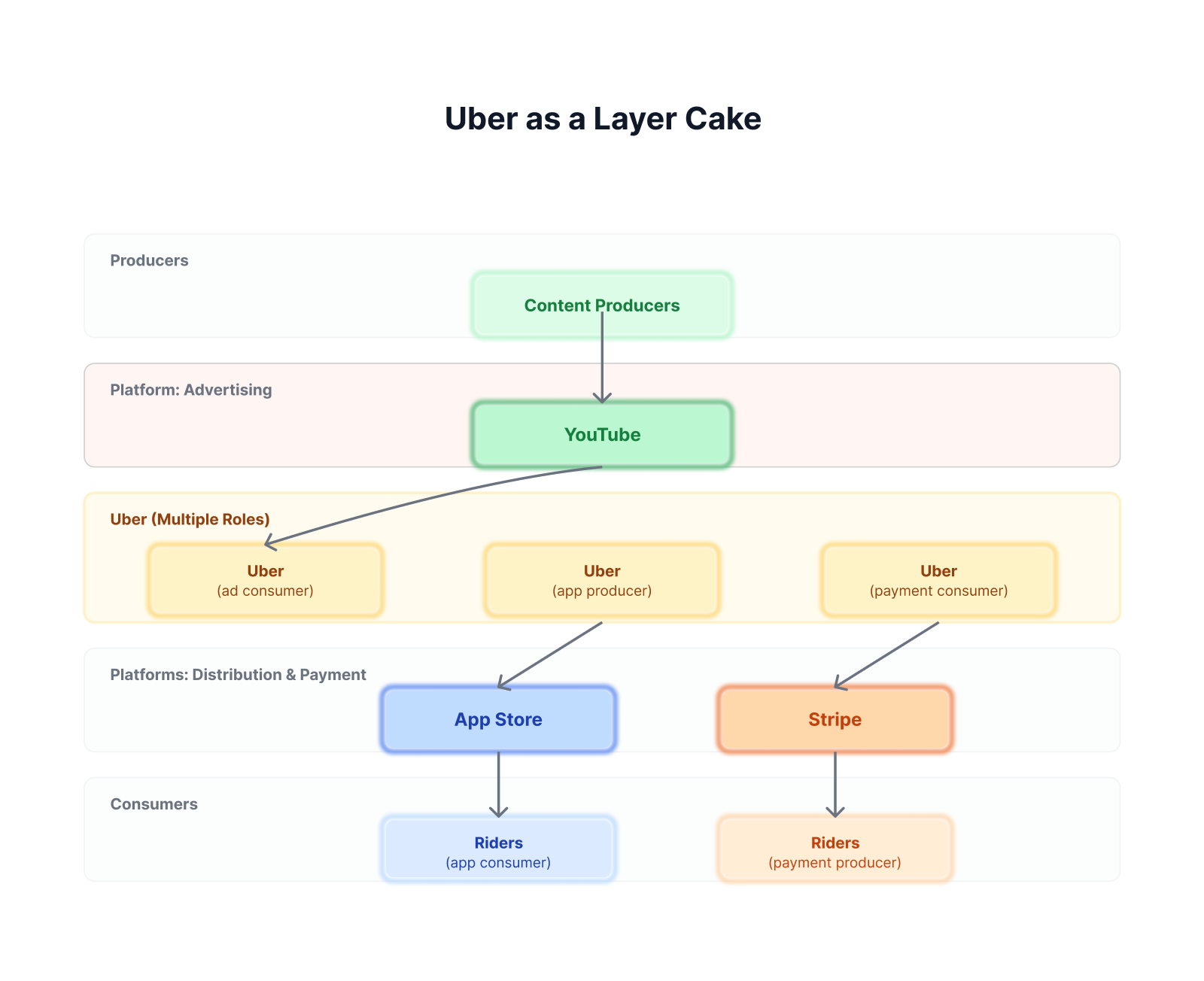
By grouping the system into contiguous layers, a layer cake emerges that alternates between automated and manual portions. Each layer receives input from upstream, adds or transforms value, and passes output downstream. The automated layers handle scale and consistency. The manual layers handle judgment, exceptions, and quality assurance.
Automated systems enabled platforms
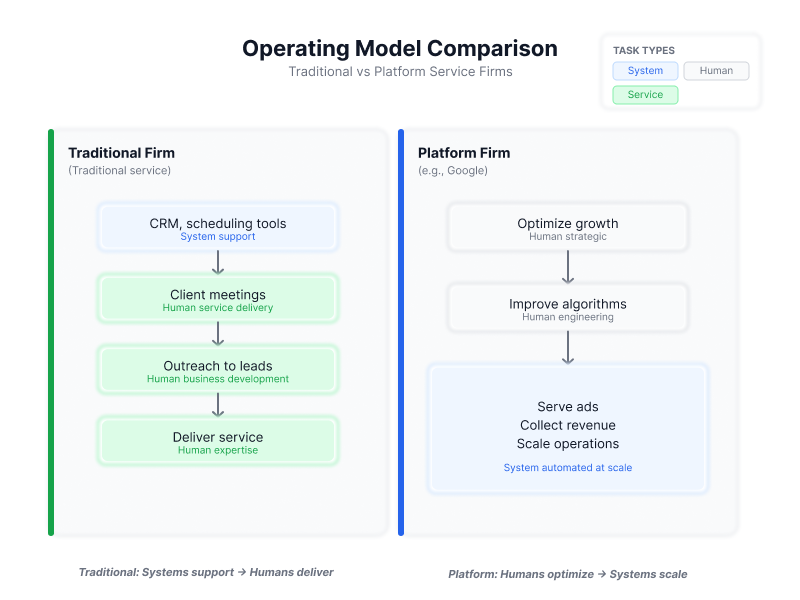
Through the early part of the Internet era, automated systems were structured as platforms. Platforms allow third-party producers to sell to consumers on a multisided marketplace. Uber connects riders and drivers, Airbnb connects guests and hosts, and the App Store connects users and developers.
Platforms scale rapidly and profit from a broad market while avoiding much of the logistics and risk of furnishing the goods and services themselves. Instead of writing millions of apps, Apple maintains the systems, rules, and ecosystem for large numbers of developers, who remain responsible for making their apps work as intended. This has a knock-on effect for the usefulness of the iPhone while allowing Apple to capture profits from a wide range of activities, from hotel bookings to ebook purchases. Similarly, Airbnb collects profits from independently operating hosts around the world without ever tidying a single room. The largest media company in the world (Meta) creates no media.
Platforms became the dominant way to scale automated systems as a business throughout the Internet era because they leveraged what the Internet could do well—matchmaking, transactions, and marketplace enforcement at scale—while delegating what the systems could not do, such as creating apps, providing rides, or offering room and board.
AI's effect on platforms
Since the mainstream release of LLMs in 2023, the equation is changing rapidly. The frontier of what automated systems can do is expanding, allowing AI companies to capture more of the value chain without relying on marketplace platforms. In this new paradigm, platforms that were once strongholds have been upended. Google Search's matchmaking between knowledge seekers and content creators is a clear example. OpenAI and Perplexity popularized AI summaries that directly answer questions rather than referring traffic, pressuring Google into following suit. What was once a multisided platform has become a first-party automated system.
AI compresses the layer cake
The vertical integration of platforms using AI gives the impression that a single company can own value chains end-to-end. Headlines suggesting AGI will replace all human labor are not hard to find. If Google can answer any question, or if Meta can create any AI entertainment, are journalists and creators still needed?
The current answer is yes. Google needs a data source from which to answer its questions. Meta needs the authenticity and feeling of connection that its creators bring.
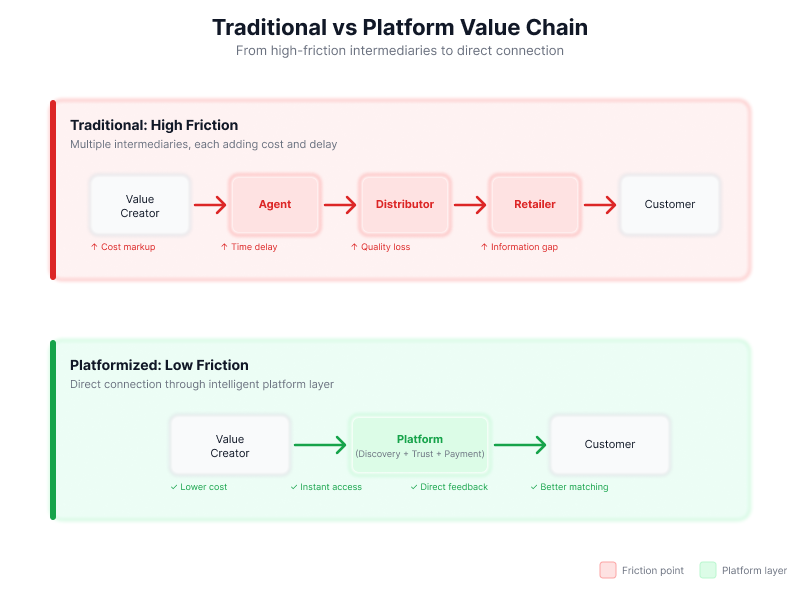
Even when AI has changed the shape of how data travels, some layer cake boundaries persist. Creators share factual observations, authentic expression, or other items of value at the top of the funnel. This passes downstream through an AI layer that provides summaries and synthesis. (The AI layer itself contains many sub-layers of automated and manual systems.) Finally, a user conducting a search consumes the output.
From this vantage point, AI is not the originator of value but rather something that compresses the digital layer cake, collapsing or removing layers entirely. This compression is not always lossless—in many cases there is measurable degradation in quality, nuance, or attribution. Accordingly, it’s important businesses measure quality impacts when adopting AI in this way.
The operational layer presents new AI opportunities
Today AI is a multi-billion dollar industry improving the efficiency of knowledge workers. Several examples address different layers in the layer cake of value creation:
| Product | Category | What it streamlines |
|---|---|---|
| Perplexity | Internet search | Obtaining exact public information |
| Abridge | AI note-taking | Preserving and recalling exact private information |
| Harvey | Legal assistance | Legal document drafting and review |
| Sierra | Customer experience | Customer support and service operations |
When companies consider opportunities to adopt AI, they need not look further than the boundaries of their own layer cakes. By examining how teams create and hand off valuable outputs to downstream systems, they can identify bottlenecks, inefficiencies, and manual effort that could be incorporated into an AI-enabled layer.
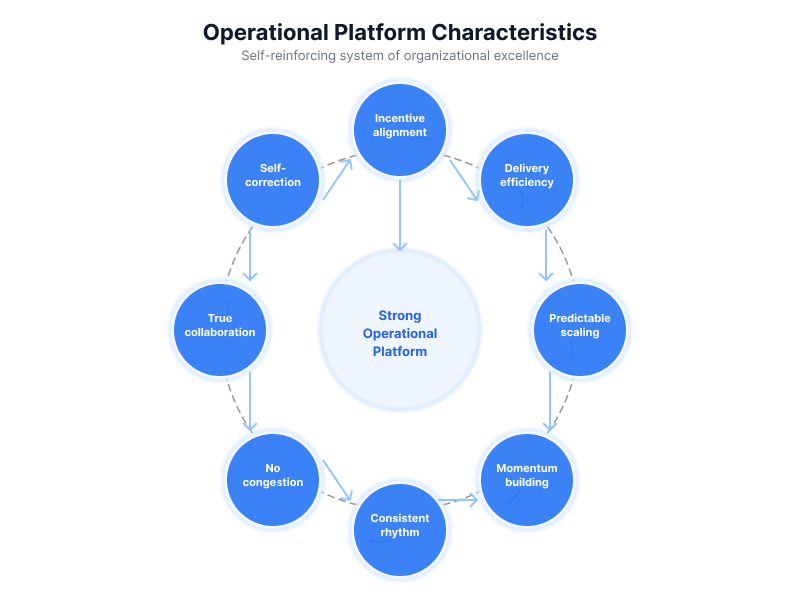
Existing systems can be restructured into AI-enabled operational layers that achieve goals such as:
| Principle | Description |
|---|---|
| Aligns incentives for talent | The most capable workers thrive, not just the most available |
| Removes delivery friction | Workers efficiently deliver value to end users |
| Scales predictably | Growth does not require proportional headcount increases |
| Creates momentum | Work compounds through captured IP, processes, and institutional knowledge |
| Maintains rhythm | The business moves forward regardless of day-to-day motivation fluctuations |
| Reduces congestion | Work does not bottleneck on individual availability |
| Enables collaboration | Structures prevent peers from undermining each other or gatekeeping value |
| Self-corrects | Poor patterns are identified and addressed systematically |
Creating operational layers based on existing systems offers lower-risk opportunities to streamline work, since quality and timeliness can be closely monitored and measured against known baselines.
While many vendors are eager to make a bigger impact by replacing entire functions, these initiatives often bear considerably more risk. Wholesale replacement requires the AI system to handle not just the routine cases but every edge case, exception, and novel situation the function encounters. It removes the human judgment that previously caught errors, maintained quality, and adapted to changing circumstances. And it creates single points of failure where a system malfunction or model degradation can halt operations entirely. Incremental adoption at layer boundaries, by contrast, preserves human oversight while capturing efficiency gains—and provides clear rollback paths when things go wrong.
Sources
1. "What Platforms Do Differently than Traditional Businesses," Harvard Business Review, 2016. https://hbr.org/2016/05/what-platforms-do-differently-than-traditional-businesses
2. "Finding the Platform in Your Product," Harvard Business Review, 2017. https://hbr.org/2017/07/finding-the-platform-in-your-product
3. "The AI Factory: What It Is & Its Key Components," HBS Online. https://online.hbs.edu/blog/post/ai-factory
4. "Artificial Intelligence, Data-Driven Learning, and the Decentralized Structure of Platform Ecosystems," Academy of Management Review, 2020. https://www.hbs.edu/faculty/Pages/item.aspx?num=59173
Ready to boost your productivity?
Try Retain and experience the power of AI-driven productivity tools.
Start Free Trial